By Riverwalk Dental Arts | November 9, 2026
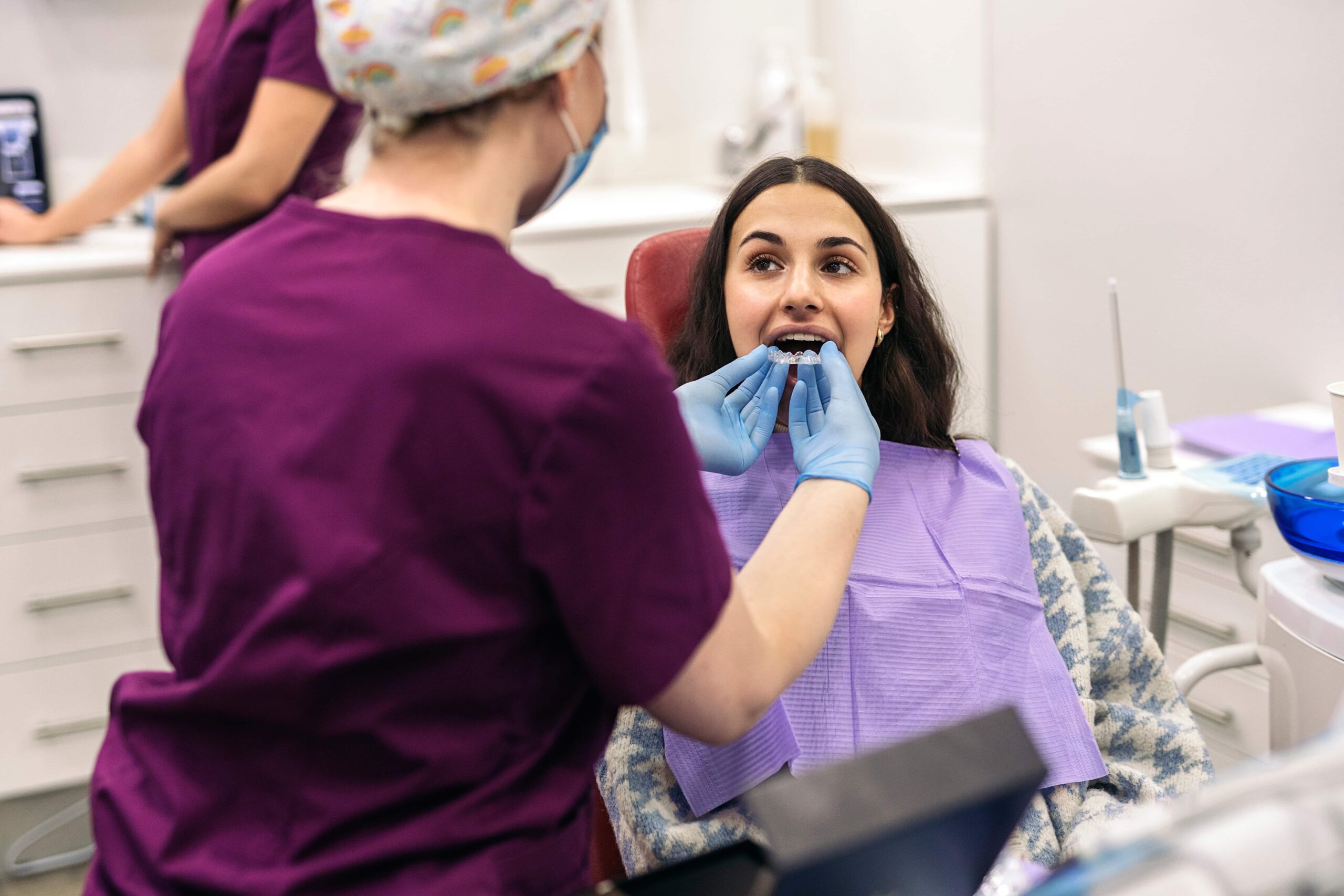
Some patients need dental work before Invisalign. Cavities, gum disease, and infected teeth must be treated first, because aligners move teeth through gum tissue and bone that must be healthy. A dentist confirms this during the exam for Invisalign at Riverwalk Dental Arts in Rock Hill.
Why does a dentist examine your teeth before Invisalign?
A dentist examines your teeth first because aligners apply pressure to teeth, gums, and bone that must be healthy enough to tolerate movement.
The American Association of Orthodontists states that existing gum or tooth damage should be treated before active orthodontic treatment begins. The pre-treatment exam uses several diagnostic tools:
- Clinical exam of teeth, gums, and existing restorations
- Digital X-rays to detect decay and bone loss
- CBCT imaging, when clinically needed
- 3D digital scan to plan aligner movement
Patients unsure what to expect can read what to expect at a first dental visit.
Which dental problems must be treated before Invisalign?
Active tooth decay, gum disease, tooth infections, and failing restorations (cracked fillings, loose crowns) must be treated before Invisalign starts.
The table below lists common conditions, typical treatments, and the reason each comes first.
| Condition | Typical treatment | Why it comes first |
|---|---|---|
| Cavities | Dental fillings, inlays, onlays | Untreated decay keeps progressing |
| Gum disease | Professional cleaning, scaling and root planing | Inflamed gums and bone loss reduce tooth support |
| Infected tooth | Root canal therapy or extraction | Infection can spread beyond the tooth |
| Failing restoration | Replacement filling or crown | Tooth shape changes can affect aligner fit |
| Impacted wisdom teeth | Wisdom teeth removal | Removed when the dentist finds they affect the plan |
How does gum disease affect Invisalign treatment?
Active gum disease must be controlled before Invisalign because tooth movement on inflamed gums and weakened bone can increase bone loss.
Gingivitis, the early stage, is often reversible with cleaning and improved home care. Periodontitis, the advanced stage, damages the bone that supports teeth. Treatment usually starts with a periodontal treatment plan, such as professional cleaning or scaling and root planing. Scaling and root planing removes plaque and tartar below the gumline.
A 2015 study of 35 patients with periodontitis in the Journal of Periodontal & Implant Science found that combined periodontal and orthodontic treatment improved gum health with both clear aligners and fixed appliances when patients maintained strict plaque control.
Patients with a history of gum disease may qualify once the condition is stable.
Do cavities and infected teeth need treatment before Invisalign?
Yes. Cavities need fillings, and infected teeth need root canal therapy or extraction, before Invisalign begins.
Untreated decay continues to progress during treatment and can reach the nerve. Dentists repair cavities with dental fillings made from materials such as composite resin, glass ionomer, and amalgam. Fillings are placed after the dentist removes the decayed portion of the tooth.
Larger areas of damage may require inlays, onlays, or crowns. Teeth with infected pulp may need root canal therapy before aligner planning begins.
Do you need teeth removed before Invisalign?
Some patients need extractions before Invisalign, such as removal of non-restorable teeth, impacted wisdom teeth, or teeth causing severe crowding.
The dentist decides based on X-rays, bite, and available space. A tooth extraction is recommended when the exam shows the tooth cannot be restored or interferes with alignment.
Can you get Invisalign with existing crowns, bridges, or implants?
Yes. Existing crowns, bridges, and implants typically do not rule out Invisalign, but the dentist must plan tooth movement around them.
Dental implants do not move under orthodontic force. A bridge moves as one unit because its teeth are joined. Tell the dentist about every crown, bridge, or implant so the plan accounts for them.
What is the order of treatment before and during Invisalign?
Treatment follows this order: exam, disease control, tooth repair, aligner planning, aligner wear, and retainer use.
The steps below show the typical sequence:
- Exam, X-rays, and 3D scan identify decay, gum disease, and infection.
- Gum and infection treatment controls active disease.
- Fillings, root canal therapy, or crowns repair damaged teeth.
- Aligner planning begins from a digital scan.
- Custom aligners move teeth in stages.
- Vivera retainers hold the final position.
Can you start Invisalign without any dental work first?
Yes. Patients with healthy teeth and gums can often start Invisalign right after the exam confirms they are candidates.
A professional cleaning may still be advised before treatment begins. Patients can review the cost of routine dental cleaning in Rock Hill.
Does dental work delay the Invisalign timeline?
Dental work delays the start of Invisalign, not the length of aligner treatment, which Riverwalk Dental Arts lists at about 12 to 18 months.
The start date depends on the condition and the treatment required. The dentist provides a schedule after the exam. Once treatment begins, each aligner set is worn for 1 to 2 weeks, with check-ins every 6 to 8 weeks.
Routine checkups during treatment help detect new cavities early. See how often you should see a dentist for recommended intervals.
Where can you get evaluated for Invisalign in Rock Hill?
Riverwalk Dental Arts offers a complimentary Invisalign consultation in Rock Hill, SC, where the dentist reviews your teeth and gums and states whether dental work is needed first.
Patients looking for Invisalign Rock Hill can contact Riverwalk Dental Arts to schedule the visit. Bring a list of medications, prior X-rays, and insurance details. New patients without insurance can also book an exam and X-rays for $169.
The office is open Monday through Thursday, 8 a.m. to 4 p.m. View the office on Google Maps at 998 Riverwalk Parkway Ste 203, Rock Hill, SC 29730.
FAQs
Can you get Invisalign with a cavity?
Cavities should be filled before Invisalign begins, because untreated decay keeps progressing during aligner treatment.
Can you get Invisalign with gum disease?
Patients with gum disease can start Invisalign only after the dentist controls the active disease and confirms stable gums.
Do you need a dental cleaning before Invisalign?
A cleaning may be recommended before treatment, depending on the plaque, tartar, and gum findings at your exam.
Do you need X-rays before Invisalign?
Dentists commonly use digital X-rays to check for decay and bone loss before planning aligner movement.
How long do you wait to start Invisalign after dental work?
The wait depends on the treatment performed and healing, and the dentist sets the start date after reviewing your case.